- 3Third keepersince Jun 2023Current
- 2Second keeperFeb 2020 – Jun 20233y 4m
- 1First keeperMar 2018 – Feb 20201y 11m
Ownership history
Every keeper change in order, with how long each one kept the car.
Free check by registration or VIN. Full report from £11.99.
Enter a UK registration to read the vehicle's DVLA record and full MOT history at no cost. The full report adds finance, write-off, theft and identity records.
Works withcarsEVsvansmotorbikes
A full report checks 200+ data points, including:
Six of the records, drawn the way they appear in the report. A full report checks 200+ data points in all; see every check.
Every keeper change in order, with how long each one kept the car.
Every recorded reading on one line. A reading that goes backwards stands out at once.
Category S write-offStructural damage recorded, 14 Sep 2023
The insurance category, the date of loss and whether it passed the identity check.
Finance agreement foundLive
Any hire purchase, PCP or conditional sale still registered, so you know who to call before you pay.
Police stolen markerNot recorded
VIN and engine numberMatch the record
High-risk registerNo marker
The police stolen marker, the high-risk register and the numbers that catch a cloned car.
Colour change: blue to grey, 2022
Every earlier registration with its dates, and any colour change the DVLA recorded.
Made-up figures, to show the layout.
Check any UK-registered car, van or motorbike by its reg or VIN, whatever the make. These are the makes buyers check most.
Logos are shown to identify the makes we check. We are not affiliated with or endorsed by any manufacturer.
A car registration check retrieves the records held against a UK registration number. At no cost, it returns the vehicle’s DVLA record (make, model, colour, engine size, fuel type, date of first registration, tax status, MOT status, CO2 and Euro status) together with every MOT test held by the DVSA and a ULEZ verdict. The full report, which is charged, adds the records that sit outside the DVLA: any finance agreement, any insurance write-off, any police stolen marker, the keeper count, earlier registrations and colours, the dates of each log book, the identity numbers and the manufacturer’s specification.
The check accepts a registration or a 17-character VIN. It requires no account. The free record is sufficient to confirm that a vehicle is what the advertisement describes; the full report is intended for the point at which a buyer is ready to pay.

Go through the V5C, the service book and the MOT record together. If the registration details don't line up, stop there.
Check a registrationEach check has a page of its own, with an example result, the source of the record and the action to take if it shows a problem.
The record behind a registration number, read field by field.
Records, log book and vehicle: the three layers to work through before paying.
Every field of the DVLA vehicle lookup, and the three dates to compare.
Each test since 2005, with mileage, failures and advisories.
Taxed, untaxed or SORN, and the current rates by registration date.
How to test a log book against the record and the vehicle.
Age from the registration date, not the plate.
Agreements recorded against the vehicle, and how to settle them.
Whether the vehicle has been recorded as destroyed.
The full list, with the source of each.
Finance, theft and write-off records in one search, each one explained.
The police marker, and the number checks that expose a cloned identity.
Category A, B, S or N, the date of loss and its effect on value.
MOT odometer readings in sequence, free, with an anomaly flag in the full report.
Whether the recorded Euro status meets the London standard, and the charge if it does not.
Answers on payment, refunds, privacy and the data guarantee are collected on the registration and HPI check FAQs page.
Inside every full report
We check 200+ data points on every full report. These are the 21 checks they come from, each one shown on the report page in plain English.
A genuine keeper who has lost the V5C can apply for a replacement online or by telephone, and GOV.UK states that it usually arrives within five to seven working days. The fee is modest. A seller who offers a car without a V5C, and with a reason why one cannot be obtained before the sale, is therefore offering something the DVLA advises buyers not to accept.
The V5C check explains how to compare a log book with the registration record, and the guide on checking that a log book is genuine lists the security features.
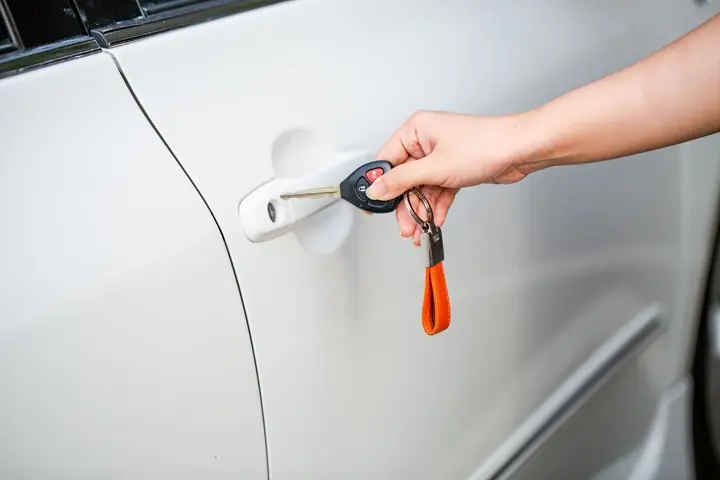
Before the fob changes hands, run the registration and read the full report. Once you've paid, a finance claim on the car is hard to undo.
A private seller is obliged to describe a vehicle accurately but is not obliged to volunteer its history. The following records are those most often absent from an advertisement.
Each report covers a single vehicle and is charged once; the price displayed includes VAT. There is no subscription and no account.
Full report
£11.99
One car, paid once. VAT included, no subscription, no account.
Start with the registrationThe basic check (MOT history, mileage, tax and vehicle details) stays free.
View the sample registration report · Pricing and payment questions
How to change the address or name on your V5C, what to send, the fee, the wait and the fine for not telling DVLA.
The online and postal ways to tell DVLA about a sale, the green slip, the tax refund, and what a missed notification risks.
How to replace a lost V5C online, by phone or by post, what it costs, and how to buy or sell a car without…
It is a search of government and commercial vehicle records using the registration number as the key. The registration is the identifier the DVLA assigns when a vehicle enters the UK register, and it links the vehicle to its tax record, its MOT tests and, through the VIN, to records kept by lenders, insurers and the police. “Car reg check”, “vehicle registration check” and “registration number check” describe the same search.
A registration check does not identify the registered keeper. Keeper names and addresses are disclosed by the DVLA solely to applicants who can show reasonable cause. The full report states the number of keepers; it does not name them.
| Record | In which check | Who holds it | Why it matters |
|---|---|---|---|
| Make, model, colour, engine size, fuel | Free | DVLA vehicle record | Whether the vehicle matches its description |
| Date of first registration, year of manufacture | Free | DVLA vehicle record | The age of the vehicle, independent of the plate |
| Tax status and expiry | Free | DVLA vehicle record | Taxed, untaxed or SORN |
| MOT status and test history | Free | DVSA MOT records | Results, recorded mileage, defects and advisories |
| CO2, Euro status, ULEZ result | Free | DVLA vehicle record, compared with TfL’s standard | Emissions and clean air zone position |
| Date of the latest V5C | Free | DVLA vehicle record | Whether the log book shown is current |
| Outstanding finance | Full report | Lenders’ agreement registers, supplied under licence | Whether a lender retains ownership |
| Insurance write-off | Full report | Insurer total-loss records | Category A, B, S or N |
| Stolen marker | Full report | Police records, via a licensed data provider | Whether the vehicle is reported stolen |
| Keepers, previous plates, colour changes, every V5C date | Full report | DVLA registration history | How the vehicle’s identity has changed |
| Scrapped, exported, imported | Full report | DVLA records | Whether the vehicle should be on the road at all |
| VIN and engine number | Full report | DVLA and manufacturer records | The numbers to compare with the vehicle and the V5C |
For eliminating a vehicle, frequently. For approving one, no.
The free record will reveal a colour that differs from the advertisement, an engine size that does not match, an expired MOT, a mileage that fell between tests and a pattern of repeated advisories. Each of those is sufficient reason not to travel. The free record cannot, however, reveal whether money is owed on the vehicle, whether an insurer has written it off or whether it has been reported stolen, because none of those facts is held by the DVLA or the DVSA. The reg check page sets out precisely where the free record ends.
Each field in the record should be consistent with the others and with the vehicle itself. Disagreement is the finding.
| Comparison | Consistent | Requires an explanation |
|---|---|---|
| Recorded colour and the vehicle | The same | Different: an unreported respray or a different vehicle |
| First registration and plate age identifier | The same half-year | Plate appears newer than the registration date |
| Year of manufacture and first registration | The same year, or one apart | Several years apart: import or long storage |
| Latest V5C date and the V5C shown | The same date | The document shown is older: it has been replaced |
| Last MOT mileage and the odometer | Odometer higher | Odometer lower |
The DVLA vehicle check page explains each field in detail. The sample registration report shows the full report’s sections in order.
Finance. Under the Hire Purchase Act of 1964 (Part III), a private purchaser acquires good title to a vehicle subject to a hire purchase or conditional sale agreement if the purchase was made in good faith and without notice of that agreement. Citizens Advice notes that the protection does not extend to motor traders, and that the buyer may have to demonstrate good faith. A finance check made before purchase removes the question.
Stolen vehicles. A thief cannot pass title. A stolen vehicle remains the property of its owner or of the insurer that has paid the owner, and the police may recover it from a later buyer. Under the Theft Act 1968, handling goods that a person knows or believes to be stolen is an offence.
Use on the road. GOV.UK states that using a vehicle with no current MOT may attract a fine as high as £1,000. Driving without insurance carries a fixed penalty of £300 and 6 penalty points. Vehicle tax does not transfer to a buyer, who must tax the vehicle before it is driven.
Selling privately or through a dealer. As Citizens Advice explains, the Consumer Rights Act 2015 obliges a dealer to supply a vehicle that is satisfactory in quality, fit for its purpose and consistent with its description, whereas a private seller need only describe it truthfully and be entitled to sell it. The difference is the reason private buyers rely most on a registration check.
An independent inspection addresses condition. The registration check addresses the record. The used car check page sets out how the two fit together with the V5C.
For registrations issued since September 2001, the two digits after the first two letters identify the half-year of issue: the last two digits of the year from 1 March, or those digits plus 50 from 1 September. A “25” plate was issued between March and August 2025; a “75” plate between September 2025 and February 2026. A private registration hides the identifier, so the registration date shown in the free record is the safer guide. The what year is my car page and the article on number plate years set out the full system.
Three kinds of vehicle produce records that look unusual but are not necessarily a concern.
Imports. An imported vehicle receives a UK registration when it is first registered here, often years after manufacture. The free record therefore shows a gap between the year of manufacture and the date of first registration, and the MOT history begins only at UK registration. The full report confirms the import. Records created abroad, such as a foreign write-off, are not held in UK data; the buyer should ask for the export documents.
Rebuilt vehicles and kit cars. Where the DVLA cannot establish a vehicle’s age or identity, it may issue a “Q” registration. Such vehicles can be entirely legitimate, but the history deserves careful reading, and the scrapped car check and the write-off record are particularly relevant.
Older vehicles. Vehicles registered before 2001 carry prefix or suffix plates, and some fields, such as Euro status, may be blank. The tax rate for a car registered before March 2001 depends on engine size rather than CO2. MOT records begin in 2005, so the history of an older vehicle starts mid-life. The MOT history check page explains how to read a history with an early gap, and the V5C check describes the older log book details a buyer should still compare.
Yes. The tax status field reads “SORN” when a Statutory Off Road Notification is in force, which means the vehicle must be kept off the public road. A SORN on a vehicle offered for sale is not itself a concern, but it explains a gap in the MOT history and invites a question about why the vehicle was laid up. The car tax check page covers the three tax statuses, and the article what SORN means explains the rules.
No charge applies to the DVLA record, the tax and MOT status, the test history with its recorded mileages, or the ULEZ verdict, and no account is needed. Only the full report is charged.
No. Keeper details are disclosed by the DVLA only to an applicant with reasonable cause; the full report states how many keepers there have been, without names.
Yes. Both terms describe a search of the records held against a registration number.
Usually, once the DVLA has processed it. If no record is found, try the VIN.
Yes for the vehicle record. MOT tests in Northern Ireland appear from 2017.
No. The seller is not notified. The full report counts previous searches without identifying who made them.
The DVLA and DVSA records are read at the time of the search. A change not yet processed by the DVLA will not appear.
Records held outside the DVLA’s public data: lender agreements, insurer write-offs, police markers, mileage irregularities, the keeper count, earlier plates and colours, log book dates, import, export and destruction records, the identity numbers, earlier searches and the maker’s specification. The report explained page lists each one.
Yes. Vans and motorcycles are held on the same register.